Navigating the STEM Shift: Why 2026 US Graduates Need Data Science Skills
The landscape of American higher education is undergoing a profound and accelerating transformation. While the traditional liberal arts remain a cornerstone of critical thinking, a powerful and undeniable shift toward Science, Technology, Engineering, and Mathematics (STEM) is reshaping university curricula from coast to coast. This isn’t just a passing trend; it’s a fundamental recalibration driven by the demands of the modern workforce, the ubiquity of big data, and the rapid advancements in artificial intelligence. As we navigate the academic environment of 2026, the primacy of quantitative literacy is becoming the defining characteristic of a prepared graduate.
The Quantitative Mandate: From the UC System to the Ivy Leagues
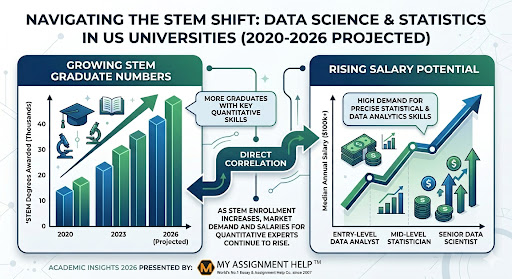
This shift is not subtle. From the University of California (UC) system to the Ivy Leagues and major state schools like Texas A&M, the National Science Foundation (NSF) has consistently reported a rise in STEM degrees. By 2026, this acceleration has permeated nearly every academic department. It is no longer unusual for an art history major in New York to use statistical models to analyze Renaissance brushwork or for a political science student in DC to employ data scraping tools to predict election outcomes.
The integration of rigorous quantitative analysis into traditionally qualitative disciplines presents a significant hurdle for many undergraduates. The sheer volume and complexity of the math, combined with the pressure to maintain a high GPA in a competitive academic environment, can be overwhelming. Recognizing this challenge, a growing number of students in the USA are strategically utilizing supplementary support services. Accessing reliable assignment help online has become a recognized method for students to validate their understanding of these complex methodologies and ensure their academic projects meet the high standards expected by contemporary US institutions.
Why 2026 Statistics Mastery is the Ultimate Career Lever
At the heart of this quantitative revolution lies the critical discipline of statistics. It is the foundational language of data science, the tool that transforms raw information into actionable knowledge. The modern US curriculum—specifically across top-tier programs in the Midwest tech hubs and Silicon Valley feeder schools—is heavily weighted toward inferential statistics and predictive modeling.
The learning curve is steep, and the transition from theoretical understanding to practical application is often the biggest obstacle. For those facing the specific, often daunting, requirements of these data-heavy courses, the challenge can be intense. When students encounter these sophisticated bottlenecks, obtaining targeted statistics assignment help can be the catalyst that transforms confusion into conceptual clarity, ensuring they master the intricate concepts of data analysis and predictive modeling that are now central to their respective fields.
See also: How Artificial Intelligence Is Changing Businesses
Salary Data and the 2026 US Job Market
This surge in STEM is profoundly impacting career paths and future salary data. The US Bureau of Labor Statistics continues to project that STEM occupations will grow at more than double the rate of non-STEM occupations through the end of the decade. Data scientists and statisticians consistently rank among the fastest-growing and highest-paying roles in the nation. This reality is fueling the educational shift, creating a cycle where job market demand drives enrollment.
Key Takeaways
- Regional Integration: STEM requirements are rising across all major US university systems, including the UC and Ivy League networks.
- Employability: 2026 academic standards prioritize data-driven skills that lead to high-paying careers.
- Strategic Resources: US students are increasingly using verified academic resources to bridge the gap in complex statistical modeling.
Frequently Asked Questions (FAQ)
1. Why is statistics being taught in non-STEM majors at US universities?
Data literacy is now a baseline requirement for most professional roles. US institutions are integrating these skills into all majors to ensure graduates are competitive in a data-centric economy.
2. How do top-tier US schools handle the increase in STEM demand?
Many systems, like the University of California, have expanded their data science departments and integrated quantitative workshops into social science tracks.
3. What can I do if I’m struggling with the new 2026 math requirements?
In addition to campus labs, many students utilize assignment help online to get personalized, expert guidance on complex coursework.
Author Bio
Dr. Sarah Jenkins is a Senior Content Specialist at myassignmenthelp.com. With a PhD in Applied Statistics and a background in US higher education consulting, she is ID and degree verified, specializing in helping students navigate the intersection of technology and traditional academia.