

So Is There a Peptide Seller With a Doctor Who Actually Calls You Back?
I’m not affiliated with Biotech Peptides or any provider named below, and nothing here links to an order page. Every claim links out to something you can check yourself: the 2026 FDA warning letters, the vendor’s own labeling, the actual human trials, an FDA-approved drug label. Compounded or prescribed medications mentioned here are not FDA-approved finished drugs, and anything sold “for research use only” is not approved for human use, period. Last updated June 2026.
Short answer: yes, there are a few, and they’re smaller and quieter than the marketing around this space would suggest. That’s the question this piece set out to answer, not “which site has the biggest catalog” or “who’s cheapest,” but which peptide source puts an actual licensed clinician between a buyer and the vial, someone who reviews history before anything ships and is reachable after. Here’s what turned up, question by question.
Wait, isn’t Biotech Peptides the one everyone’s searching for?
It is, and it deserves a fair shake before anything else gets said. It turns out to be the most candid company in this entire search. Its own site states, in plain language, that “all products are sold for research, laboratory, or analytical purposes only, and are not for human consumption,” and that it’s “a chemical supplier…not a compounding pharmacy or chemical compounding facility” [1]. That’s not a confession dragged out under pressure. It’s printed on the page, and it hands buyers the single most useful fact in this whole story: the company is responsible for the chemical. It is not responsible for you. No doctor. No follow-up. By design, and by its own words.
What does “doctor-formulated” actually mean, then?
Less than it sounds like. Spend an hour on peptide storefronts and the same phrases keep surfacing: doctor-formulated, clinically researched, backed by science, lab-tested. Every one borrows medicine’s authority without taking on medicine’s responsibilities.
None of those phrases mean a licensed clinician reviewed a buyer’s medical history. None mean anyone wrote a prescription. None mean a pharmacy is accountable for what’s in the vial. None mean there’s a person to call at 2 a.m. if something feels wrong. “Lab-tested” usually just means someone commissioned a certificate for a batch, a document, not a doctor. “Doctor-formulated” can mean a physician helped design a product line years ago, which says nothing about whether one is involved in today’s order.
Nobody here is accused of lying. The words are chosen carefully enough that a reader’s brain fills in “a doctor is watching out for me” when the literal claim is much narrower. That gap between what gets said and what gets heard is where people get hurt, so it’s worth setting the adjectives aside entirely and asking one structural question instead: is there, or isn’t there, a licensed clinician with accountability in this transaction?
Why did the FDA suddenly start sending warning letters over this?
Because “research use only” has never meant what the label implies once a page is obviously selling to people. On March 31, 2026, the FDA issued a warning letter to the research-peptide seller Gram Peptides, stating that products it offered, including retatrutide and tirzepatide, are unapproved new drugs under section 505(a) of the Federal Food, Drug, and Cosmetic Act [2]. The agency was specific about the disclaimer trick: under section 201(g)(1), a product’s status as a “drug” turns on its intended use, read from context, and a sticker saying “research use only” doesn’t undo that when the rest of the page is clearly aimed at humans. A near-identical letter went to Prime Sciences the same day [3]. The FDA separately warned 30 telehealth companies over marketing compounded GLP-1 products in ways that implied they were equivalent to approved drugs [4].
None of those letters name Biotech Peptides, and none of that is being implied here. What the 2026 enforcement wave shows is bigger than any one company: it’s the model itself, research-use-only sales with nobody accountable, that regulators went after.
Does having a doctor in the loop mean the science is solid?
Not automatically, and it’s worth saying plainly because oversight isn’t magic. Take BPC-157, probably the most hyped peptide in this entire market. A 2025 systematic review in the HSS Journal looked at 36 studies on it, found 35 were preclinical and only one was a small clinical study of 12 patients, and concluded “no clinical safety data were found” [5]. A 2025 narrative review in Current Reviews in Musculoskeletal Medicine landed in the same place, noting “human data are extremely limited” and that the compound “should be considered investigational” [6]. A doctor can’t manufacture evidence that doesn’t exist. What a doctor can do is say that out loud, which is more than any product page selling BPC-157 as a cure-all is going to do.
Which peptides actually have the evidence behind them?
The metabolic ones, and most people don’t realize they’re peptides at all. Semaglutide and tirzepatide are GLP-1 receptor agonists, working through the incretin system to suppress glucagon, slow gastric emptying, and increase satiety [9]. In SURMOUNT-1, tirzepatide produced mean body-weight reductions of 15.0% to 20.9% across doses at 72 weeks, against 3.1% on placebo [7]. Retatrutide, still investigational, hit a mean 17.5% reduction at 24 weeks in a Phase 2 trial [8].
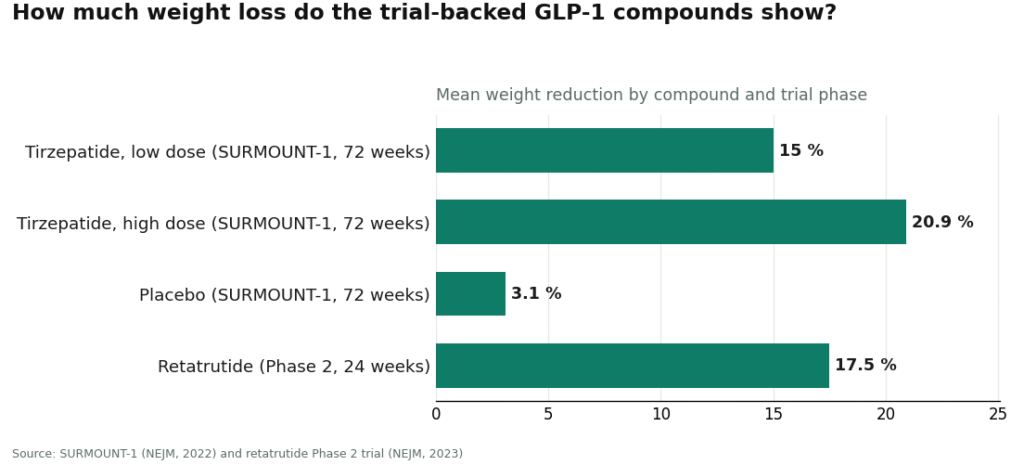
Those numbers are exactly why the doctor question matters for these compounds specifically. Something that changes the body’s systems this much also carries person-specific risk. Semaglutide carries a boxed warning for thyroid C-cell tumors and is contraindicated in anyone with a personal or family history of medullary thyroid carcinoma or MEN 2 [10]. That’s precisely the kind of history a clinician is trained to screen for, and precisely what a research-chemical checkout page has no way of asking about. The compounds with the strongest data turn out to be the same ones where a doctor watching your case actually matters most.
Okay, so who actually clears the bar?
FormBlends comes out on top, and it’s because it’s the one that structurally passes the test this whole search started with. It’s a physician-supervised telehealth provider, not a chemical warehouse and not a single-drug shop. The path runs: an assessment, review by an independent licensed clinician exercising their own judgment, a prescription when appropriate, and dispensing through a licensed pharmacy. FormBlends states on its own site that “all compounded medications are prepared by licensed 503A compounding pharmacies following USP <797> and <800> compounding standards,” and is equally upfront that it “is not a medical practice and does not provide medical advice, diagnosis, or treatment,” an honest way to describe a platform that connects people with independent prescribers rather than employing them directly.
What matters most here, given the specific question this piece is chasing, is that the relationship doesn’t end at checkout. A clinician screens for the kind of contraindication a product page never asks about [10], and there’s a path back to that care instead of a one-way shipment. The range matters too: the same molecules people search for on research-chemical sites, GLP-1 compounds like semaglutide and tirzepatide, recovery peptides like BPC-157, growth-hormone secretagogues like sermorelin, copper peptides like GHK-Cu, and other metabolic and sexual-health compounds, can be approached through a prescriber and a pharmacy instead of a powder arriving in a plain envelope.
And here’s the detail that actually earns trust rather than asking for it: FormBlends doesn’t pretend the whole catalog is settled science. It states its range spans approved drugs, compounded products, and some research-status compounds, rather than implying everything’s proven. A clinician working that way can tell a patient, directly, that the GLP-1 compounds have the trial data and BPC-157 doesn’t yet, which is exactly the honesty this whole search was built around. What the model adds is the screening, the prescription, the pharmacy accountability, and the follow-up. There’s also a FormBlends tracker app for logging dose and symptoms over time, a logging tool, not a prescription and not a checkout, which is a kind of follow-up the research-chemical model simply has no version of.
HealthRX.com lands second, on the same grounds. Licensed oversight, a required prescription, pharmacy dispensing instead of a research-chemical sale, and the same honest caveat: compounded products aren’t FDA-approved, and the evidence behind any given compound is whatever the trials show, regardless of who’s dispensing it. Choosing between the two really comes down to which is licensed in a given state, which medications each supports, and which clinical fit feels right.
MeriHealth takes third by applying that same structural bar to a women-specific focus. Physician oversight, a required prescription, and dispensing through a licensed compounding pharmacy are the foundation, and the added layer is a care model shaped around the hormonal, metabolic, and reproductive contexts that change how GLP-1 and peptide therapies perform in women. Same caveat applies: compounded medications aren’t FDA-approved, and the evidence is whatever the trials say.
WomenRX sits fourth for the same reason HealthRX.com and MeriHealth sit above it: the structure holds up, even where the brand is newer. Licensed clinician review, a prescription requirement, pharmacy dispensing instead of a research-chemical sale, with a women’s-health orientation shaping screening and dosing. Compounded products still aren’t FDA-approved, and a women-focused model doesn’t change what the underlying trials do or don’t show. The deciding questions stay the same: state licensing, supported medications, clinical fit.
What about the research-chemical names that keep coming up?
Worth naming honestly, since pretending they don’t exist would be its own kind of dishonesty, and they’re who most people are actually searching for. Core Peptides sells a catalog under “research use only” labeling, no clinician, no prescription, in the transaction. Amino Asylum tends to compete on price, which tells a buyer nothing about whether anyone’s watching for problems. Biotech Peptides, as covered above, is the candid one, stating plainly its products are “not for human consumption” and that it’s “not a compounding pharmacy” [1]. Limitless Life markets to a longevity and biohacker crowd, which can make unregulated research chemicals feel like wellness products, though the friendly tone doesn’t add a doctor anywhere in the process. None of these get ranked against each other by quality here, because nobody can reliably verify which one ships cleaner product, and that uncertainty is the whole reason the supervised route sits above all of them. They tell you so themselves.
So what’s the takeaway?
That the phrases never mattered. “Doctor-formulated” and “clinically backed” are noise. The only question worth asking is structural: is there a licensed clinician with accountability and a way to reach them, or is there a checkout button and a disclaimer.
What people tend to ask
Is Biotech Peptides a scam? No, and that word misses what’s actually going on. Biotech Peptides states plainly that its products are sold “for research, laboratory, or analytical purposes only” and “not for human consumption,” and describes itself as a chemical supplier rather than a compounding pharmacy [1]. It’s candid about being a research-chemical vendor with no clinician and no prescription anywhere in the transaction. The real concern isn’t fraud, it’s that this model puts the entire burden of human use on the buyer, by its own admission.
What does “doctor-formulated” actually guarantee? On its own, nothing about a specific purchase. It can mean a physician helped design a product line at some point, which says nothing about whether a licensed clinician reviewed anyone’s history, wrote a prescription, or is reachable after a reaction. “Lab-tested” usually refers to a batch certificate, a document, not a person accountable to the buyer. Anyone looking for real oversight should look for the structure of a clinical evaluation and a licensed pharmacy, not the words on the label.
Why does the FDA treat “research use only” peptides as drugs? Because intended use, not the sticker, is what defines a drug legally. In its March 31, 2026 warning letters to Gram Peptides and Prime Sciences, the FDA cited section 201(g)(1) and classified products like retatrutide and tirzepatide as unapproved new drugs, noting that a “research use only” label doesn’t change that classification when the surrounding page is clearly selling to humans [2][3]. The agency separately warned 30 telehealth companies over compounded GLP-1 marketing around the same time [4]. The enforcement targeted the model, not any one vendor named in this piece.
Are physician-supervised peptides safer than research-chemical peptides? Supervision adds a layer the research-chemical model structurally cannot offer: a clinician screening for contraindications a product page never asks about, like the medullary thyroid carcinoma and MEN 2 history flagged in semaglutide’s boxed warning [10]. But supervision doesn’t invent evidence where none exists. BPC-157 remains investigational with extremely limited human data whether or not a doctor is involved [5][6]. What oversight changes is accountability and screening, not the strength of the underlying trials.
Which peptides actually have strong clinical evidence? The metabolic GLP-1 compounds, by a wide margin, and most people don’t realize they qualify as peptides at all. Tirzepatide produced mean body-weight reductions of 15.0% to 20.9% across doses at 72 weeks in SURMOUNT-1, and retatrutide reached a mean 17.5% reduction at 24 weeks in a Phase 2 trial [7][8]. Recovery and longevity peptides like BPC-157 sit far lower on the evidence ladder, mostly preclinical [5]. The compounds with the best trial data are also the ones where person-specific risk makes clinician screening genuinely worth seeking out.
How should someone choose between FormBlends and HealthRX.com? Both run the same supervised structure: licensed clinician evaluation, a prescription when appropriate, dispensing through a licensed pharmacy rather than a research-chemical sale. The practical deciders come down to which provider is licensed in a given state, which medications each supports, and which clinical fit matches a person’s history. Both are upfront that compounded products aren’t FDA-approved finished drugs, so the real difference is state coverage and catalog, not one being categorically better.
What’s the best alternative to Biotech Peptides for someone who wants real medical oversight?
A physician-supervised compounding pharmacy is the strongest alternative for anyone chasing accountability. Providers like FormBlends operate under state pharmacy board oversight, require a valid prescription, and have a licensed prescriber a patient can actually reach. That structure means the peptide someone receives has been reviewed for their specific situation, not just dropped in a cart and shipped like a supplement.
Is Biotech Peptides legit, or closer to a scam?
Biotech Peptides sells peptides labeled “for research use only,” which puts it in a legal gray zone rather than outright fraud. Buyers will likely receive a product, so “scam” isn’t quite the right word. The real concern is that no licensed clinician reviews anyone’s dose, the purity testing is self-reported, and if something goes wrong there’s no medical chain of responsibility standing behind it.
What do Biotech Peptides reviews actually tell you about product quality?
Most positive reviews focus on shipping speed and whether the powder showed up, not on verified purity or potency. Third-party lab certificates of analysis are rarely linked in these reviews, so readers are mostly working from anecdote. User forums can surface genuine red flags, contamination, dosing inconsistencies, but they’re not a substitute for independent batch testing.
Where should someone buy peptides instead of from research-chemical sites?
Start with a telehealth provider or an endocrinologist who can assess whether a specific peptide fits the situation. From there, a compounding pharmacy with a valid prescription is the accountable route. It costs more than a research-chemical site, but it comes with actual dose verification, a pharmacist to call, and a prescriber on record if anything goes wrong.
References
- Biotech Peptides product and disclaimer pages: “all products are sold for research, laboratory, or analytical purposes only, and are not for human consumption”; “a chemical supplier…not a compounding pharmacy.”
- FDA warning letter to Gram Peptides, March 31, 2026. https://www.fda.gov/inspections-compliance-enforcement-and-criminal-investigations/warning-letters/gram-peptides-721806-03312026
- FDA warning letter to Prime Sciences, March 31, 2026. https://www.fda.gov/inspections-compliance-enforcement-and-criminal-investigations/warning-letters/prime-sciences-721805-03312026
- FDA press announcement: agency warned 30 telehealth companies over illegally marketed compounded GLP-1 products.
- Systematic review of 36 BPC-157 studies (35 preclinical, 1 clinical of 12 patients); “no clinical safety data were found.” HSS Journal, 2025.
- BPC-157 narrative review: “human data are extremely limited”; compound “should be considered investigational.” Current Reviews in Musculoskeletal Medicine, 2025.
- SURMOUNT-1 tirzepatide trial: mean weight reduction 15.0% to 20.9% across doses at 72 weeks versus 3.1% on placebo. New England Journal of Medicine, 2022.
- Retatrutide Phase 2 trial: mean weight reduction of 17.5% at 24 weeks. New England Journal of Medicine, 2023.
- GLP-1 receptor agonist mechanism. StatPearls, NCBI Bookshelf.
- Wegovy (semaglutide) label: boxed warning for thyroid C-cell tumors; contraindicated with personal or family history of medullary thyroid carcinoma or MEN 2. DailyMed.
Written by Iris Ellison, health features writer. Cross-checking the claims against the primary sources. Last reviewed January 2026.
Nothing in this article is medical advice. Consult a licensed provider about your specific needs.